A fish food timer dispenser helps keep aquatic pets fed on a precise schedule, reducing daily chores and supporting stable water quality. This guide highlights top options from Amazon that balance reliability, moisture resistance, and ease of use. Read on to compare features, capacities, and feeding modes across popular models, so you can choose the best timer feeder for your tanks, whether you keep bettas, small community tanks, or larger setups.
Summary of chosen products:
| Brand | Model | |||
|---|---|---|---|---|
| FREESEA | Automatic Fish Feeder | Unknown (top-loading design) | Battery | 8h/12h/24h schedules with manual feeding |
| Aoyar | Automatic Fish Feeder | 200 ml | Battery | 3 fixed intervals; moisture-proof lid |
| FISHNOSH | Automatic Fish Feeder (Model-ML) | Unknown | Battery | Up to 9 feedings per day |
| Petbank | Automatic Fish Feeder | 200 ml with 16 grids | USB rechargeable | Moisture-resistant, precise 2 g per grid |
| Petbank | Automatic Fish Feeder with LCD | 200 ml | USB rechargeable | Long battery life, adjustable schedule |
FREESEA Automatic Fish Feeder For Aquarium
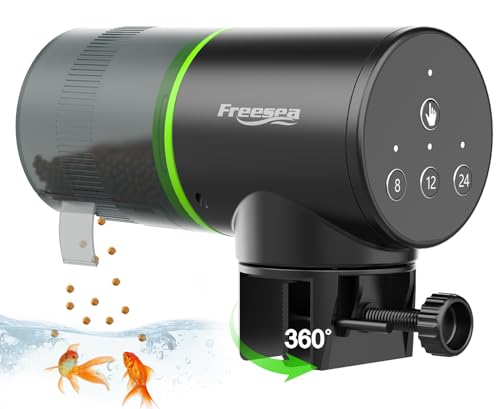
The FREESEA automatic feeder offers both manual and automatic modes. Users can schedule feedings at 8-hour, 12-hour, or 24-hour intervals, making it convenient for vacations or long workdays. The design emphasizes simple operation: a single button adjusts the timer. A key advantage is its 360° rotation mechanism, which distributes food evenly to ensure all fish receive a portion. The unit supports a range of food types, including flakes, pellets, and powders, making it versatile for various species. Moisture resistance helps maintain freshness during storage and prevents clogging, which is important for small to mid-sized tanks.
In practice, the feeder’s open design allows you to add more food without removing the timer unit, reducing maintenance interruptions. This feature is helpful for busy households or those who like to adjust portions based on fish size or tank density. The device’s basic interface is accessible to beginners, while still providing reliable, repeatable feed times for experienced aquarists. Overall, it’s a practical option for standard home aquariums with moderate feeding needs.
Automatic Fish Feeder Dispenser For Aquarium: 200ml Capacity

The Aoyar feeder prioritizes a larger capacity with a 200 ml reservoir and three fixed intervals at 8, 12, or 24 hours. Its setup is straightforward: choose a mode, then rely on the built-in timer to rotate the feeding cup. A moisture-proof lid minimizes moisture exposure, helping prevent clumping of certain foods and maintaining quality over days away from the tank. Manual feeding is available for quick top-ups, making it flexible for unpredictable schedules. The device is designed with compatibility for small to mid-sized tanks in mind, including tanks with and without lids.
Users should consider the recommended feeding cadence for their fish; small species may do well with 24-hour cycles, while larger or more active fish might require more frequent feeding. The 200 ml capacity reduces the frequency of refills during longer trips. It’s a balanced option for hobbyists looking for a dependable timer feeder without extra bells and whistles.
FISHNOSH Automatic Fish Feeder (Model-ML)

FISHNOSH markets a newer generation of automatic feeders designed for ease of use during busy periods or vacations. It supports up to nine feedings per day, with flexible scheduling to fit various tank ecologies. The design emphasizes user-friendly operation—no complex programming required, and the refill process is straightforward, often described as simple to reset. This model is suitable for both small tanks and larger aquariums or ponds where more precise daily feeding is desired. While the features focus on schedule flexibility, the physical build aims to minimize food waste and avoid spillage during automated cycles.
Consider this option if you need multiple daily feedings without micromanaging each interval. The device’s limit on the number of feedings still aligns well with many freshwater setups, particularly where stable feeding times support healthier water parameters. The model is a practical choice for households that want a reliable, mostly automatic solution with minimal setup friction.
Petbank Automatic Fish Feeder For Aquarium

Petbank’s feeder emphasizes precision feeding with 16 separate grids inside the container, allowing up to 15 individual meals in one unit. Each grid holds up to about 2 grams, enabling accurate portion control to maintain water quality. The moisture-resistant design and automatic closing after each feeding help reduce clumping and keep food dry, which is particularly important for pellets and powders. Two installation options—adjustable clamp base or suction cup—make it adaptable to various tank configurations, including tanks without hoods or with hooded tops. It is compatible with a wide range of foods, though it’s not recommended for shrimp or flakes.
USB rechargeability supports longer operation between charges and reduces the need for frequent battery replacements. This model suits aquarists who want a reliable, low-maintenance feeder with precise portioning and flexible mounting. It’s well-suited for households with multiple tanks or for those who value modular feeding options across different tank sizes.
Petbank Automatic Fish Feeder With LCD

This Petbank model pairs a long-lasting USB-powered design with an LCD display to help owners program schedules more precisely. Its large 200 ml reservoir is suitable for extended trips and daily use alike. The feeder supports customizable schedules, allowing multiple feedings per day, while the battery backup ensures operation during power outages when used with USB power as the primary source. The device is designed for straightforward refills and resets, with clear indications of feeding times. It’s a practical choice for aquarists who want a dependable system with a clear interface and robust battery life.
When evaluating this option, consider your tank’s feeding needs, whether you require more than one feeding per day, and how often you’ll be away from your tank. The LCD feedback helps in quick adjustments, and USB charging reduces ongoing costs. This feeder is a good fit for hobbyists seeking predictable feeding without complexity or frequent maintenance.
Buying Guide: How To Choose A Fish Food Timer Dispenser
- Capacity and food type: Look for a reservoir that fits your typical feeding volume and matches your fish food type (flakes, pellets, powders). Larger tanks or multiple fish may benefit from bigger capacities to reduce refills.
- Feeding schedule options: Three or more programmable feedings per day offer flexibility for busy households or varied fish species. Ensure the device supports your preferred intervals (8/12/24 hours) and manual feeding if needed.
- Moisture control: Moisture-proof lids or sealed openings help keep food dry, reduce clumping, and extend freshness—especially important for pellets and powders.
- Power options: Battery-powered feeders work during power outages, while USB rechargeable options reduce ongoing costs. Some models offer both power sources for redundancy.
- Mounting versatility: Choose a model with adjustable clamps or suction cups suitable for tanks with or without hoods. Easy mounting saves time during setup and makes repositioning simple.
- Maintenance and refilling: Refill mechanics should be straightforward, with clear access to the food compartment. Consider whether you prefer split compartments or a single large reservoir for different food types.
- Durability and build quality: Materials should resist moisture, corrosion, and impact. A reliable feeder minimizes jams and misfeeds, which helps maintain water quality.
- User interface: A simple control panel or clear indicator lights reduces the learning curve for beginners. An LCD screen can be helpful for precise scheduling.
- Species compatibility: Some fish are more or less aggressive about food portions. If you keep diverse species, a model offering precise, small portions can prevent overfeeding and water issues.
- Cost of ownership: Consider long-term costs such as battery replacements or the frequency of refills. USB-powered models may offer lower long-term costs and better sustainability.
Across these options, the best choice depends on tank size, feeding frequency, and how long you’ll be away. For simple, reliable vacation feeding, models with moisture protection and clear scheduling tend to perform consistently. For hobbyists who manage multiple tanks or want granular portion control, feeders with 16-grid systems and adjustable portion size provide the most flexibility.